Climate Change and the Great Barrier Reef: What's Happening and How You Can Help
Climate change is the single greatest threat to the Great Barrier Reef. There have been six mass bleaching events since 2016. The 2024 event had the largest footprint ever recorded. In 2025 a sixth consecutive event followed. This guide explains what that means, what is happening at Moore Reef near Cairns, what Sunlover does about it, and what you can do too.
What is climate change, and why does the reef feel it first?
Climate change is the long-term shift in global temperatures caused by rising greenhouse gases in the atmosphere. These gases trap heat that would otherwise escape into space. The result is a planet warmer than at any point in recorded human history.
The oceans absorb roughly 90% of this excess heat. That makes coral reefs some of the earliest and most affected environments on Earth. Coral reefs cover less than 1% of the ocean floor. Yet they support around 25% of all marine species.
For corals, temperature matters more than almost any other factor. When ocean temperatures rise just 1 to 2 degrees Celsius above the seasonal maximum, even for a few weeks, corals begin to bleach.
What is coral bleaching?
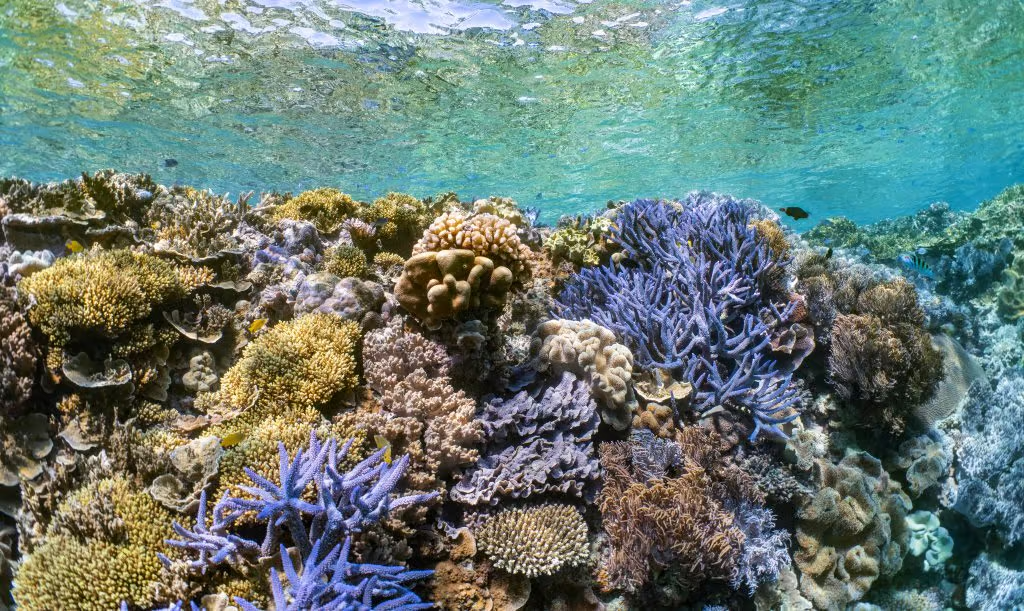
Corals are animals, related to jellyfish. Inside their tissue live microscopic algae called zooxanthellae. These algae provide up to 90% of the coral's energy and give it colour. When water gets too warm, the coral expels the algae. Without it, the coral turns white and begins to starve. If temperatures return to normal quickly, the coral can recover. If the stress persists, the coral dies.
Before 1998, mass bleaching on the Great Barrier Reef had never been recorded. It has now happened six times since 2016. That is climate change, made visible.
Bleaching history of the Great Barrier Reef
The first recorded mass bleaching event, driven by El Nino-related heat stress.
A second mass bleaching event affecting widespread sections of the reef.
Two consecutive events caused widespread coral mortality, with an estimated 50% of coral cover lost in the worst-affected northern areas. These were the first back-to-back events.
Further bleaching, though less intense. Fast-growing Acropora corals showed some recovery between events.
73% of surveyed reefs showed bleaching. This was the largest footprint in recorded history and the first simultaneous bleaching across all three reef regions.
The sixth mass bleaching since 2016, and the second consecutive year. Aerial surveys confirmed widespread bleaching in the northern reef and Torres Strait.
What is happening to the reef right now?
AIMS monitoring data published in 2025 shows the largest annual decline in hard coral cover in two of three reef regions since monitoring began 39 years ago. Fast-growing Acropora corals, the branching species most visible to snorkellers, were among the hardest hit.
The reef is not dead. It retains exceptional biodiversity and recovers between events. But the GBRMPA Outlook Report 2024 is direct: climate change remains the greatest threat to the reef.
Climate change does not act alone on the reef
Coral bleaching. Warmer water causes coral to expel the algae providing 90% of its nutrition. Prolonged bleaching leads to coral death.
Ocean acidification. As oceans absorb more carbon dioxide, they become more acidic, weakening the structures corals use to build reef skeletons.
Crown-of-thorns starfish. Warmer, nutrient-rich water can favour outbreaks of this coral-eating starfish, which damages reefs when numbers climb.
Intensified cyclones. Warmer seas fuel more intense cyclones, causing physical damage to reef structures.
Species under pressure. Warming oceans alter where reef-dependent species live, from sea turtles to manta rays.
Water quality decline. More intense rainfall increases agricultural runoff, reducing water clarity and smothering recovering coral.
What Sunlover Reef Cruises is doing about it
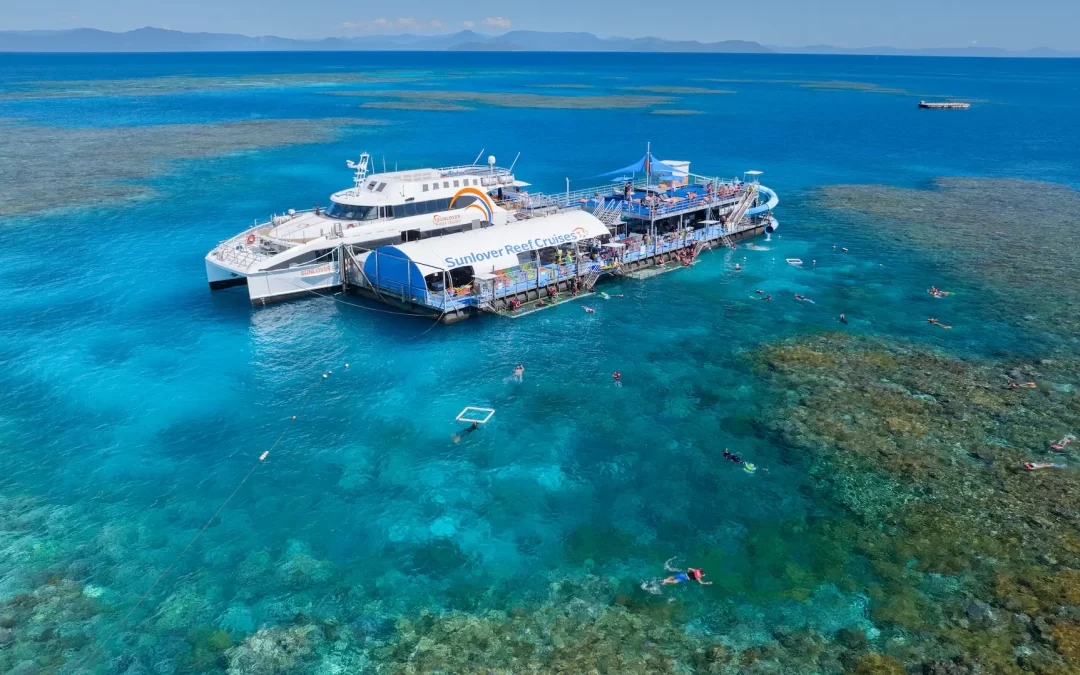
Sunlover has operated at Moore Reef since 1991. Our response to climate change is a documented, independently audited program of action. We hold Ecotourism Certification from Ecotourism Australia, renewed and audited for more than 20 years, and were inducted into the ECO Certification Hall of Fame in 2025.
Pest species management. During weekly reef surveys, our Reef Research Team removes Crown-of-thorns starfish and Drupella snails when we find them in damaging numbers. These are targeted removals that support reef resilience, not constant intervention.
Eye on the Reef citizen science. Guests are invited to log reef health, species sightings, and bleaching observations through GBRMPA's monitoring program.
Turtle rehabilitation. We partner with the Cairns Turtle Rehabilitation Centre and facilitate turtle releases at Moore Reef.
Monthly carbon tracking. We track diesel and electricity use monthly and complete the annual reporting workbook with Ecotourism Australia. We do not claim carbon neutrality. We claim a documented, improving reduction journey.
Tourism Reef Protection Initiative. Sunlover is a foundational member of GBRMPA's TRPI, a 15.1 million dollar Australian Government program to strengthen reef resilience through tourism-led conservation.
What you can do on your reef visit
Never touch coral. Corals are living animals. Even light contact breaks tissue and can introduce disease. Stay neutrally buoyant and watch your fins.
Use reef-safe sunscreen. Apply mineral-based sunscreen at least 30 minutes before entering the water. Available onboard Sunlover.
Bring a reusable bottle. Sunlover has refill stations throughout the pontoon.
Take nothing from the reef. No coral, shells, or marine life. Removal is illegal in the Marine Park.
Follow your Reef Guide. Our Master Reef Guides know Moore Reef and their briefings protect both the reef and your experience.
Share what you saw. People who experience the reef firsthand are its most powerful advocates.
What you can do at home
Reef conservation does not end when your tour does. You can switch to a green energy plan, reduce meat consumption, choose non-stop flights, and support reef science by donating to AIMS, the Great Barrier Reef Foundation, or the Resilient Reefs Foundation. You can contact your elected representatives, choose ECO Certified operators for future reef activities, and share your reef experience with others.
Come see it. Help protect it.
Every Sunlover ticket includes the GBRMPA Environmental Management Charge, paid directly to reef management. Your visit actively contributes to its future.
Book your reef tour or visit our sustainability page.
Sources and further reading
AIMS coral bleaching events
GBRMPA Outlook Report 2024
AIMS Annual Summary Report 2024/25
Ecotourism Australia ECO Certification
IPCC Sixth Assessment Report
Resilient Reefs Foundation
Our Green and Gold Promise
Sunlover has committed to the Green and Gold Promise, Tourism Australia's national pledge for responsible travel. After more than 20 years of Ecotourism Certification, the commitment was a natural fit. The Promise is built on five principles, and our daily reef operations already live each one.
Eye on the Reef monitoring, foundational TRPI membership, and pest species removal during weekly surveys protect Moore Reef for the future.
Turtle rehabilitation with the Cairns Turtle Rehabilitation Centre, and reef etiquette briefings on every tour.
Monthly carbon tracking and Ecotourism Certification, independently audited every year for more than two decades.
We acknowledge the Traditional Owners of the Sea Country we operate on, and recognise their enduring connection to the reef.
Australian owned and operated since 1991, supporting local crew, research partners, and reef science.
Learn more at Tourism Australia's Green is Our Gold.