Of all the things that stop people booking a dive course, the medical is the one that causes the most quiet worry and gets the least clear explanation. So here is what is actually involved, what happens if you tick “yes” to something, and why leaving it until the last minute is the one genuine mistake you can make.
The short answer
There is no medical examination required to learn to dive in Australia. There is a questionnaire. Most people complete it in 2 minutes, answer no to everything, and never think about it again.
If you answer yes to something, you are not out. You simply need a doctor to review that one thing and sign the form. Most people who need a sign-off get one.
What the form actually is
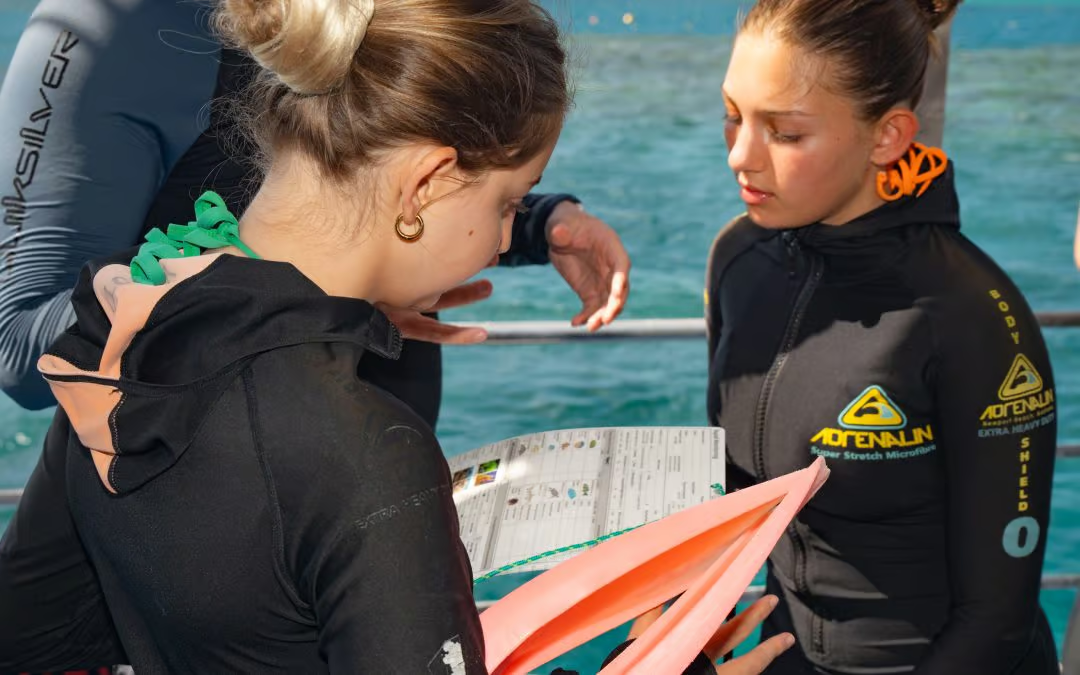
Every recognised training agency uses the same document: the RSTC Diver Medical Participant Questionnaire. It was rewritten in 2020 by a panel of diving physicians specifically to stop sending people to the doctor unnecessarily, and it is far more sensible than the version many people remember.
It comes in 2 parts. The first page asks 10 broad questions. If you answer no to all of them, you sign it and you are done. If you answer yes to any, you turn to the section that expands that question into more specific ones — and quite often those follow-ups rule the concern out without a doctor being involved at all.
What the first page covers
- Recent surgery, injury, or a problem that stops you doing moderate exercise
- Being over 45 combined with certain risk factors
- Heart or circulation conditions, or blood pressure medication
- Lung conditions, including asthma and collapsed lung history
- Ear or sinus problems, or ear surgery
- Neurological conditions, including seizures, blackouts, and head injury
- Recurring back or joint problems
- Diabetes
- Conditions affecting stomach, intestine, or digestion
- Mental health treatment, or use of prescribed psychoactive medication
That last one deserves more space than a bullet point, and it gets it in a separate piece we are publishing tomorrow.
What “see a doctor” actually means
It does not mean a full dive medical unless the doctor decides one is warranted. It means a GP looks at the specific thing you flagged, considers it against diving, and either signs the form or does not.
2 things worth knowing:
Not every GP is comfortable signing. Some will happily assess it; some will refer you to a doctor with diving medicine training because it is outside what they usually see. Neither response is a problem, but the second one takes longer, which is the whole reason to start early.
The form travels with you. A signed form is generally accepted by dive centres worldwide, so the effort is not specific to one booking.
The conditions people ask us about most
Asthma
Asthma is no longer an automatic exclusion, and has not been for years. What matters is the type, how well it is controlled, and whether it is triggered by exercise, cold or emotion. Many well-controlled asthmatics dive. This is a conversation with a doctor, not something we can assess and not something to decide from a forum post.
Blood pressure and heart medication
Blood pressure medication is common among divers and often entirely compatible with diving. But this is the one place on the form where the specific drug matters as much as the condition, and beta blockers are the reason.
Immersion is not a neutral environment. The moment you are in the water, hydrostatic pressure squeezes blood out of your arms and legs and into your chest. Central blood volume rises, and so do the filling pressures in your heart and lungs. Cold water adds to it by constricting the peripheral vessels. Breathing denser gas at depth makes the work of breathing harder. Then add the possibility of having to swim against a current at the end of a dive.
A healthy circulation absorbs all of that without noticing. What your doctor is weighing is whether yours has the reserve to do the same.
Beta blockers are the specific concern. They work by blunting the heart rate response to exertion — which is precisely the response you need when you have to work hard unexpectedly underwater. The UK Diving Medical Committee treats them as acceptable at low dose but less preferred than the alternatives, and indicates a diver taking them should be able to reach at least 90 per cent of their age-predicted maximum heart rate on an exercise test.
There is a second issue. Non-selective beta blockers can narrow the airways, which is why lung function testing is often recommended alongside. Narrowed airways and dense gas at depth is not a combination anyone wants to discover at eighteen metres.
Other classes are generally viewed more favourably — ACE inhibitors and mild vasodilators such as amlodipine among them. Diuretics are used, though dehydration carries its own significance for divers. None of this makes one tablet good and another bad. It means the conversation is worth having specifically, rather than assuming a tablet is a tablet.
Worth knowing as well: hypertension itself is a recognised risk factor for immersion pulmonary oedema, where fluid leaks into the lungs during a dive. People with raised blood pressure begin immersion with higher filling pressures already. So control matters, not simply the presence of a prescription.
To be completely clear: do not change or stop your medication in order to go diving. That decision belongs to the doctor who prescribed it, and stopping blood pressure medication carries risks of its own. What we are asking is that you raise diving specifically at your appointment — naming the drug and the dose — rather than assuming it will be fine.
If you can, see a doctor with diving medicine training; in Australia many have trained through the South Pacific Underwater Medicine Society. The UK Diving Medical Committee publishes its guidance publicly and in plain English, and it is a reasonable thing to take along to the appointment. It is guidance rather than a rule book, and your doctor’s judgement comes first.
Ears and sinuses
The most common practical issue in diving, and the one most likely to affect your actual day rather than your paperwork. If you have had grommets, perforations, or ear surgery, get it looked at. If you simply cannot clear your ears on a plane, that is worth mentioning to your instructor — it is usually technique and it is usually fixable.
Pregnancy
Diving is not recommended during pregnancy. There is no research establishing a safe threshold, so the guidance across every agency is to wait.
Age
Being over 45 is not a barrier. It appears on the form only in combination with other risk factors, and it exists to prompt a conversation rather than to stop anyone. Plenty of people certify well past that.
Why timing is the part that actually goes wrong
Here is the failure we see. Someone books a course for their Cairns holiday, fills in the form on the morning of day one, ticks yes to something they had not thought about, and there is no doctor available on the outer reef at 7am.
That is a lost course day at best. It is a lost booking at worst, and it is entirely avoidable.
Read the form before you book. If anything applies to you, see your GP while you are still at home with time to spare. Bring the signed form with you. Our health checklist sets out exactly what we ask and why.
What we are not
We run dive training. We are not doctors, and nothing on this page is medical advice. We cannot tell you whether your condition is compatible with diving, and you should be wary of any dive operator who says they can.
What we can do is tell you what the form asks, what happens next, and how long it usually takes — so that the medical side is something you handle calmly in advance rather than something that ambushes you at the marina.
Common questions
Do I need a dive medical to do an introductory dive?
You complete the same questionnaire. The threshold for needing a doctor’s sign-off is the same, because you are breathing compressed air at depth either way.
Can I do the form on the day?
You can, and most people do, because most people answer no to everything. The risk is entirely on you if you answer yes to something.
What if I am not sure whether something counts?
Answer yes and let the follow-up questions sort it out. The 2020 form is designed so that a yes on page one often resolves to a no once you read the detail.
Does the sign-off expire?
Practice varies between operators. 12 months is a common expectation. If your circumstances change, the form should be completed again regardless of dates.
Next steps
Read the questionnaire, deal with anything it raises now rather than later, and then stop worrying about it — for most people this is a 2-minute step that never comes up again.
Our SSI courses are bookable now, running from the Moore Reef pontoon on the outer Great Barrier Reef. Full details on the Learn to Dive page, and the wider picture in our guide to getting scuba certified in Australia.