Reef Wildlife
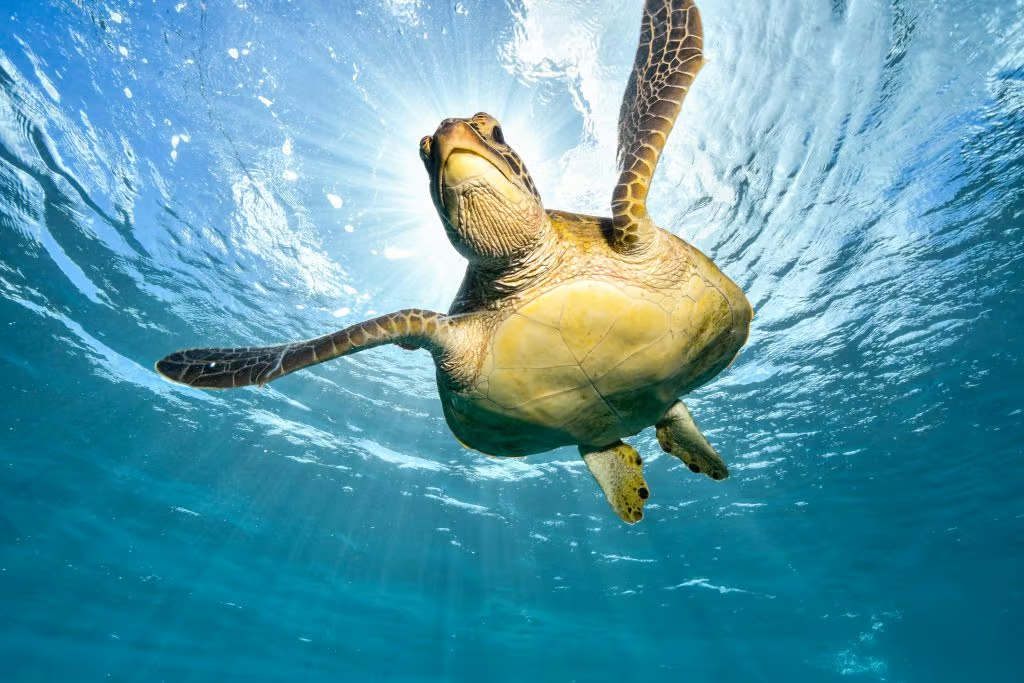
Six of the world’s 7 marine turtle species live on the Great Barrier Reef. At our Moore Reef sites, the 2 you are most likely to meet are the green turtle and the hawksbill. Here is how to tell them apart, why our pontoon turtles are so relaxed, and how to share the water with them respectfully.
The short version
- 6 of the 7 marine turtle species in the world are found on the Great Barrier Reef.
- At our Moore Reef sites, our crew most often see green turtles and hawksbill turtles.
- Tell them apart by the beak: hawksbills have a narrow, bird-like beak; green turtles have a short, rounded snout.
- Turtles breathe air. Never touch, chase or ride a turtle, and never block its path to the surface.
Meet the green turtle
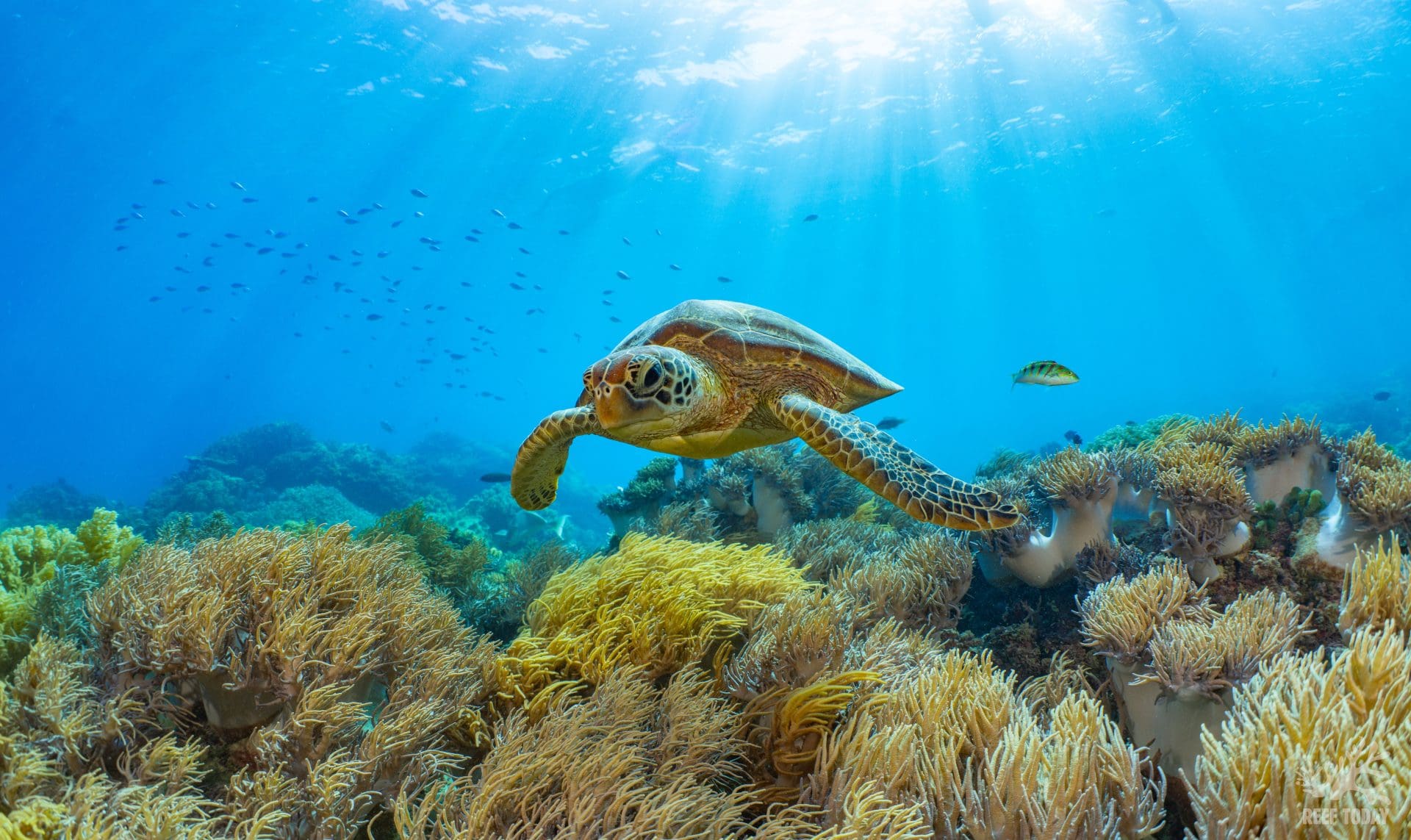
The green turtle (Chelonia mydas) is one of the largest hard-shelled turtles. The Reef Authority reports that nesting females on the Great Barrier Reef average about 107 cm in shell length and 130 kg. Young green turtles eat a mix of animals and plants, but adults are mostly herbivores, grazing on algae and seagrass, with mangrove fruit and jellyfish also on the menu.
Green turtles grow up slowly. The Australian Museum notes they take 30 to 50 years to reach maturity, and the Reef Authority reports that green turtles on the reef first breed at around 45 years old. Breeding season on the Great Barrier Reef runs from about late October to February.
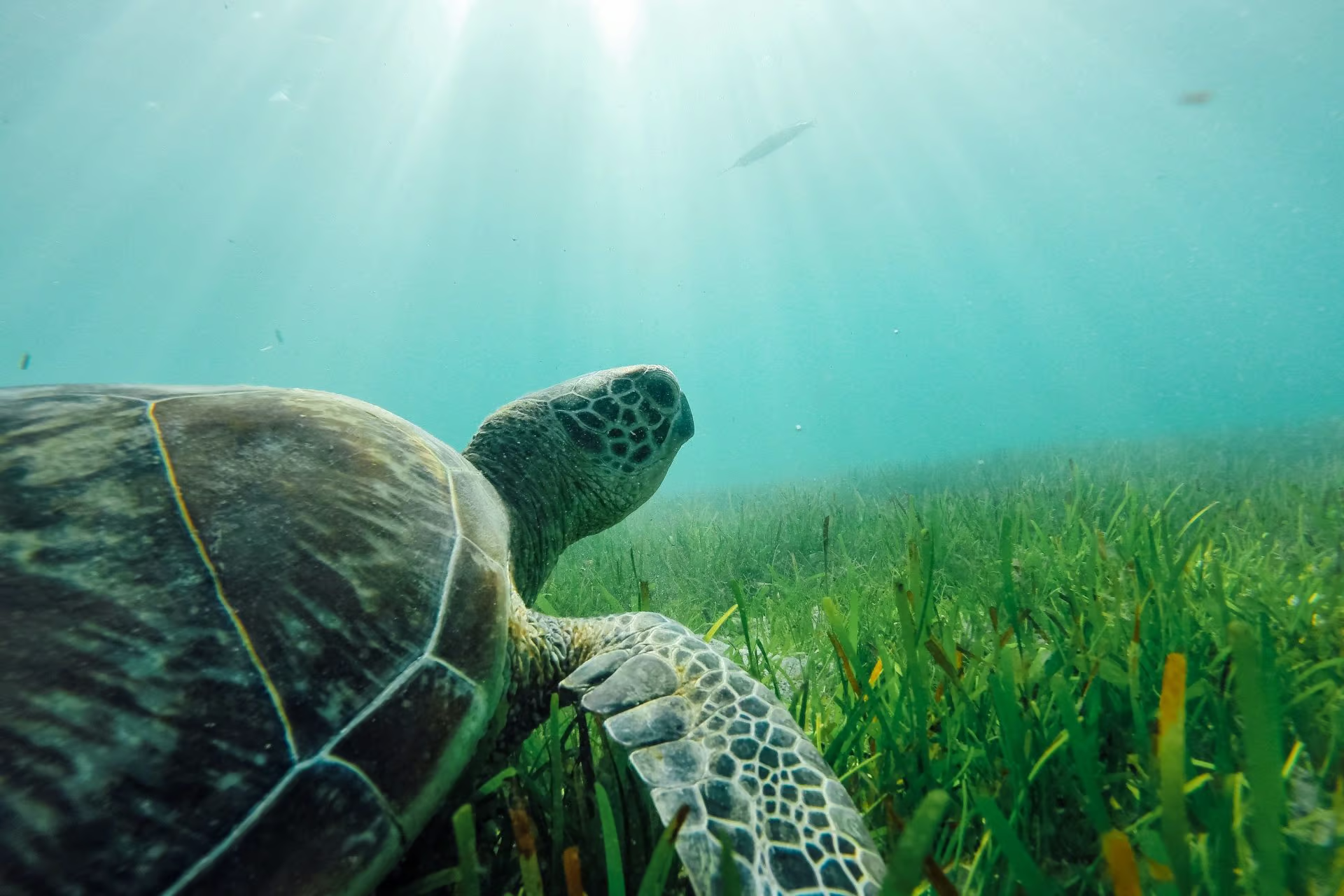
Green turtles also face an unusual challenge. A turtle’s sex is set by the temperature of the sand its egg develops in, with warmer sand producing more females. A 2018 study by Jensen and colleagues, with researchers from NOAA, the Queensland Government, WWF-Australia and California State University, found that 99.1% of juvenile green turtles from northern Great Barrier Reef nesting beaches were female, linked to warming sand temperatures.
Our pontoon turtles: calm, curious and camera-ready
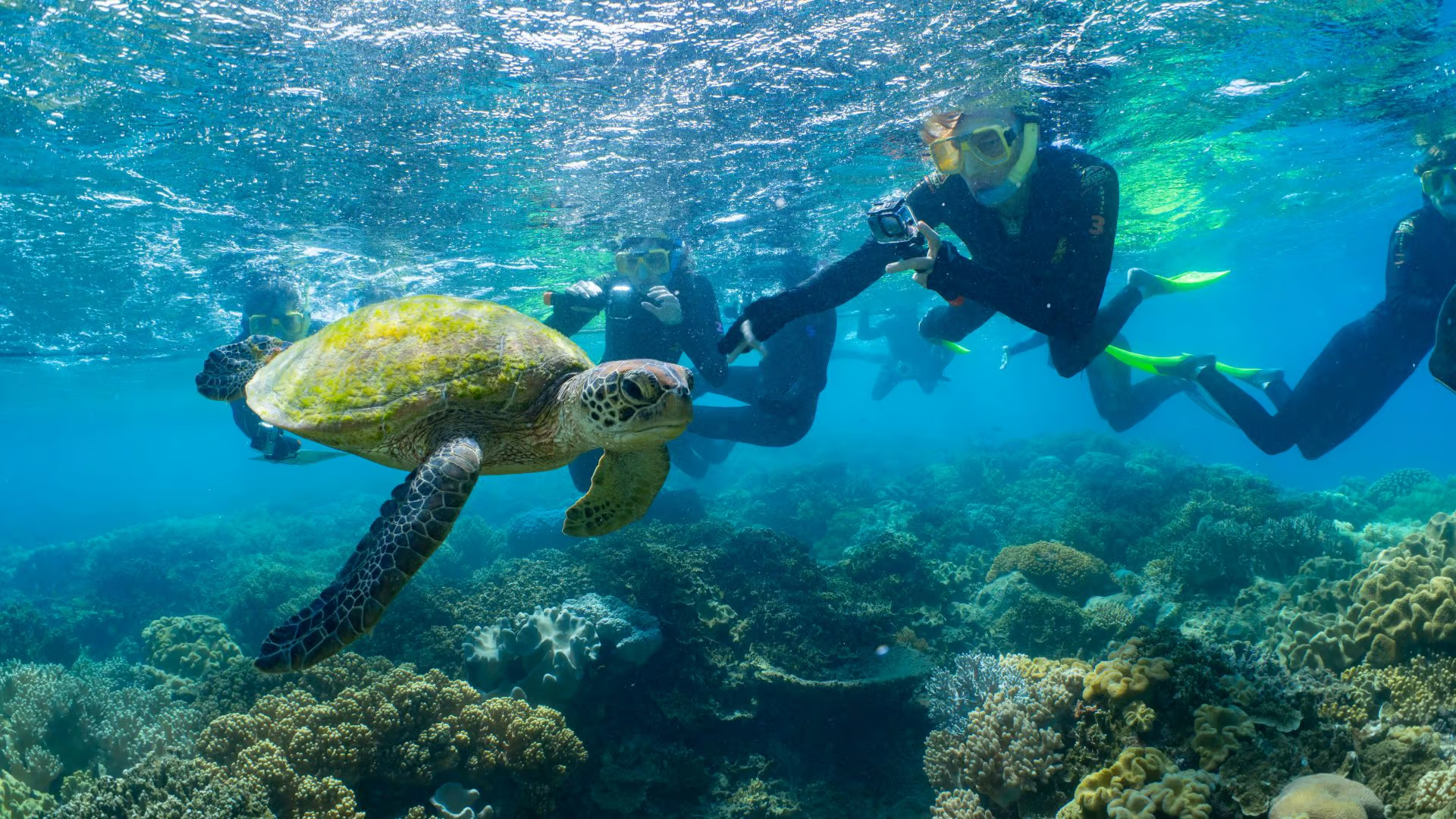
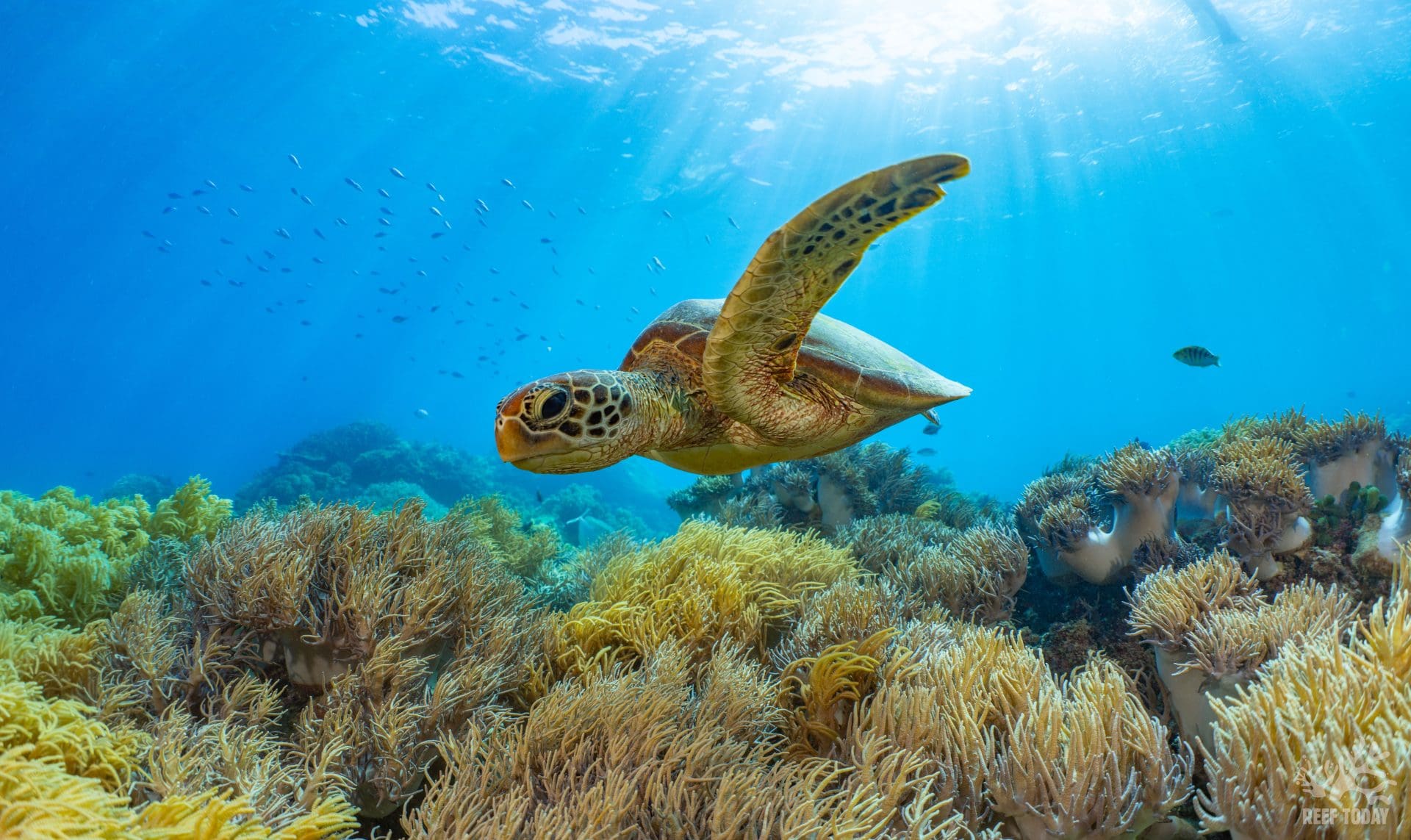
In the wild, green turtles are normally shy and quick to swim away from people. The young green turtles around our Moore Reef pontoon are different. Our crew and marine biologists see them every day cruising calmly past snorkellers, spending long stretches searching for food on the reef, and sometimes seeming to pose for guests’ photos.
Our team’s theory is that these young turtles have learned that an area busy with people all day has fewer large predators around, so it feels like a safe place to feed and rest. This is our crew’s observation rather than a published study, but it is one of the reasons turtle encounters at Moore Reef are so special. It is also why we work hard to keep those turtles relaxed, and why the way you behave in the water matters so much.
Meet the hawksbill turtle
The hawksbill (Eretmochelys imbricata) is named for its narrow, pointed beak, which looks like a bird of prey’s. Its scientific name refers to the thick shell plates that overlap like roof tiles. The Reef Authority reports that hawksbills on the reef average about 82 cm in shell length and 50 kg.
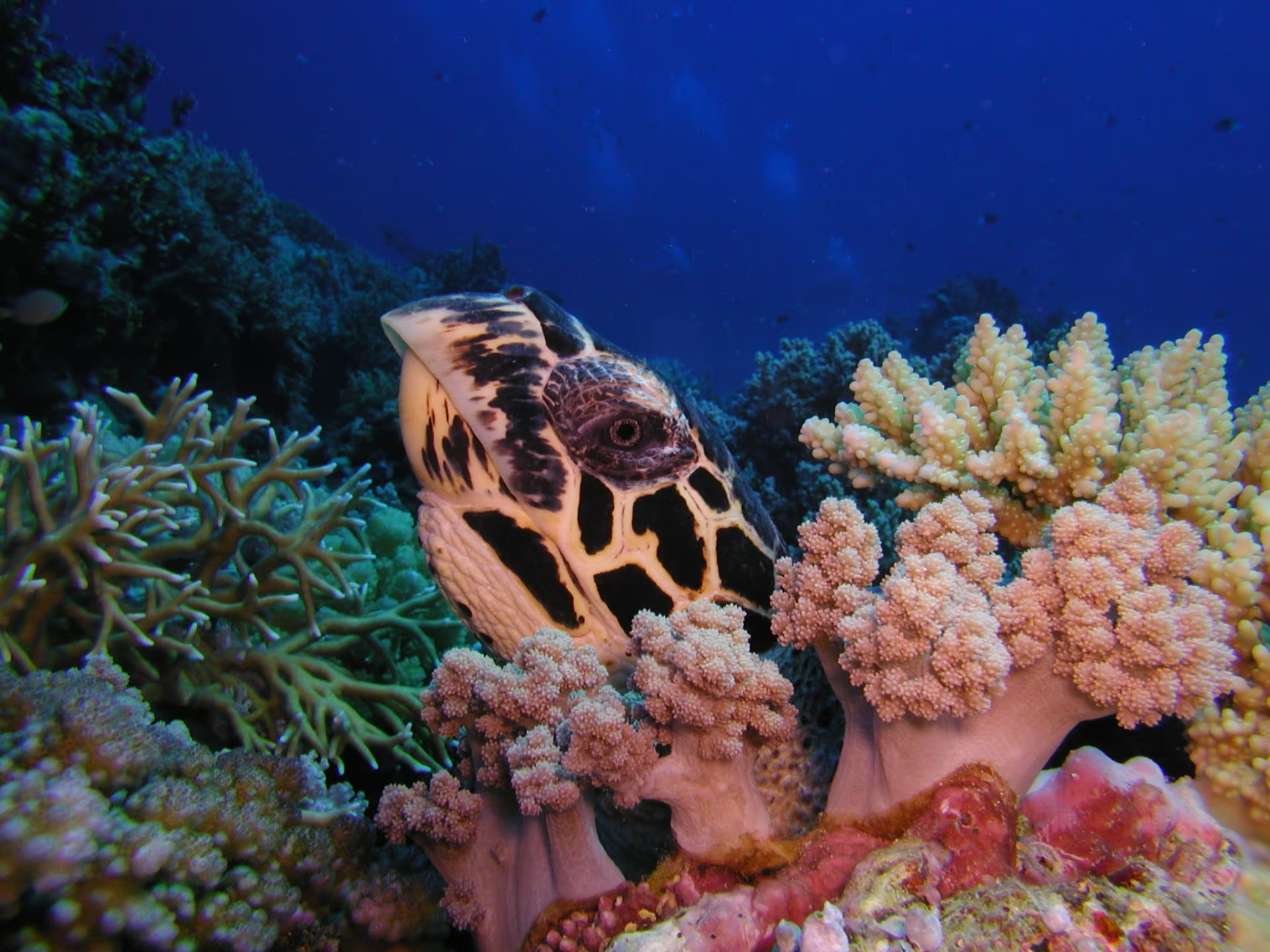
Hawksbills are reef specialists. They feed mainly on sponges, along with seagrass, algae, soft corals, shellfish and sea cucumbers, using that narrow beak to reach into gaps in the coral. Their beautiful shell was once traded as “tortoiseshell”, and international trade is now banned under CITES. The Australian Museum notes hawksbill numbers have fallen by almost 80% over about 120 years, and the Reef Authority reports that the nesting population at Milman Island in the northern Great Barrier Reef has declined by about 3% a year since 1990.
Green or hawksbill? A quick guide
Green turtle
Chelonia mydas
- Head and beak
- Short, rounded snout
- Shell plates
- Smooth, sitting edge to edge
- Main food (adults)
- Algae and seagrass
- Average adult size on the reef
- About 107 cm and 130 kg (nesting females)
- Conservation status
- IUCN Endangered; Vulnerable in Australia
Hawksbill turtle
Eretmochelys imbricata
- Head and beak
- Narrow, pointed, bird-like beak
- Shell plates
- Thick and overlapping, like roof tiles
- Main food (adults)
- Sponges, plus soft corals, algae and shellfish
- Average adult size on the reef
- About 82 cm and 50 kg
- Conservation status
- IUCN Critically Endangered; Vulnerable in Australia
Why turtles need a clear path to the surface
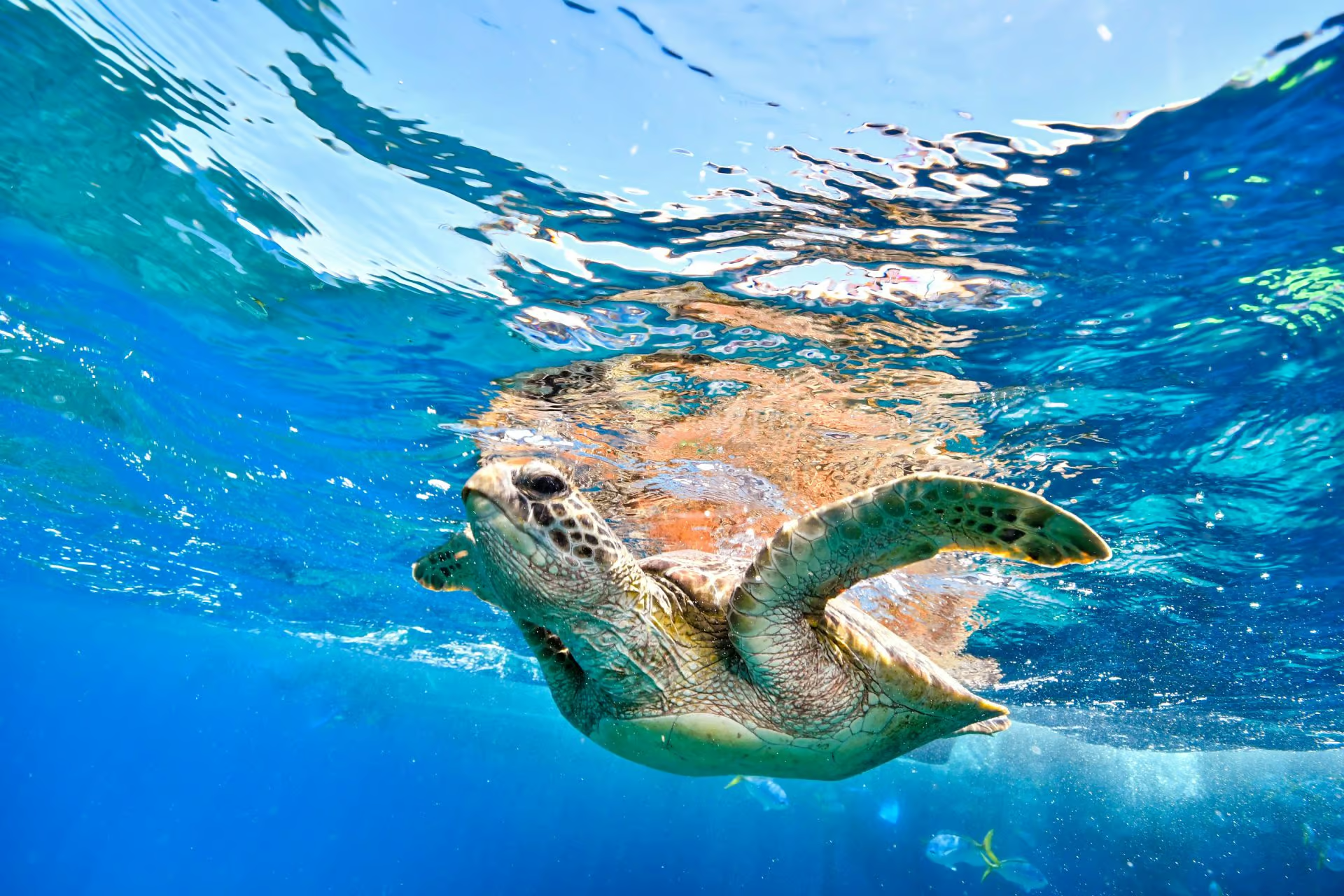
Turtles are reptiles and breathe air, just like us. The Australian Museum notes that green turtles must surface about every half hour to breathe. When a turtle starts swimming upwards, it needs open water above it. If snorkellers crowd over the top of a turtle, it has to change course or wait, which uses energy and causes stress.
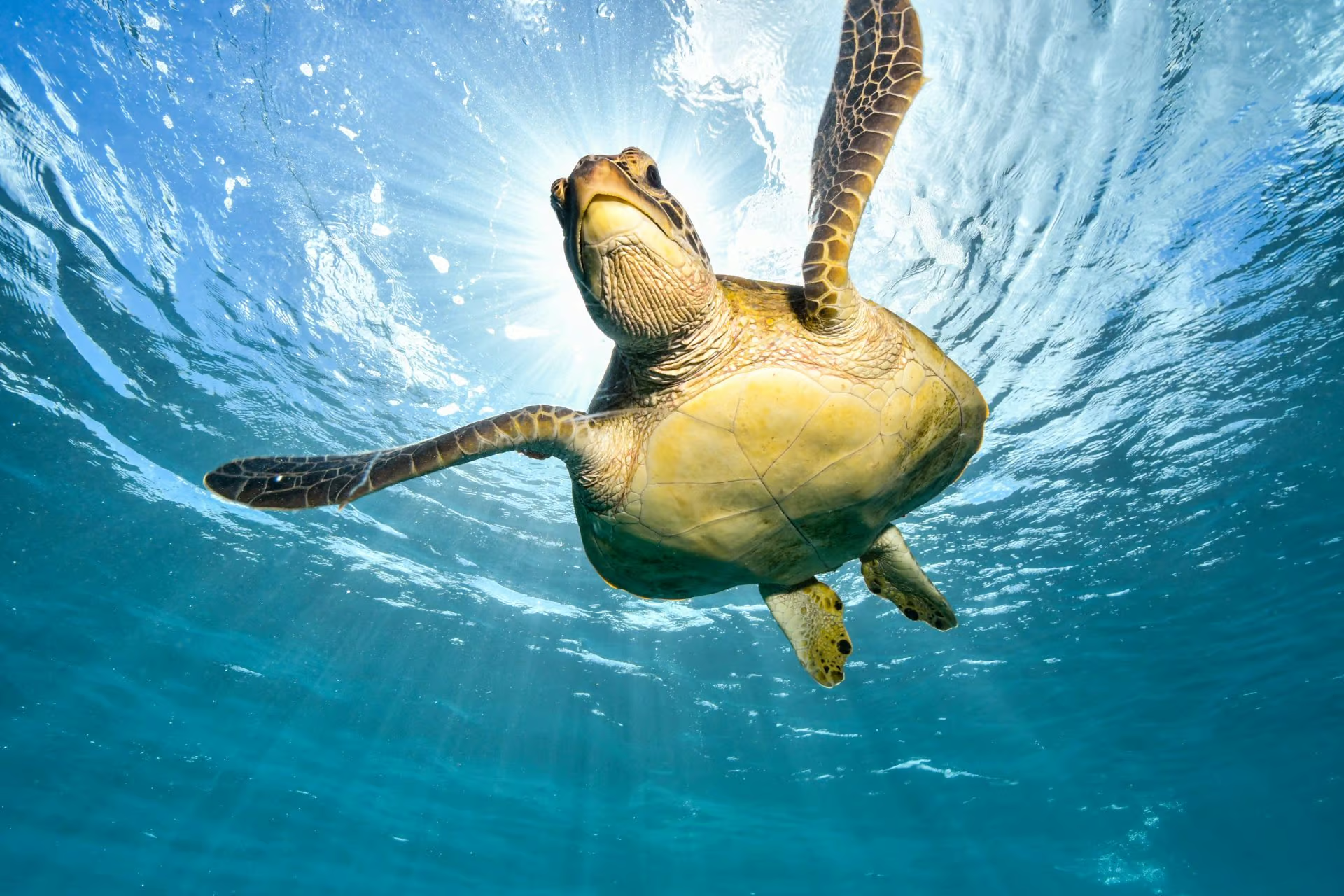
The golden rule: if a turtle starts to swim up, move aside and give it a clear column of water to the surface. Never float directly above a turtle.
How to behave around turtles
The Reef Authority asks snorkellers and divers to be mindful of all marine life: do not touch, prod or chase animals, and avoid making loud noises. All 6 species of turtle on the reef are threatened, so every encounter counts.
- Never touch, hold, chase or ride a turtle. Not even a gentle pat on the shell.
- Never block its path to the surface. Stay to the side, not on top.
- Keep a respectful distance and let the turtle choose how close to come.
- Do not crowd it. If other snorkellers are already watching, give the turtle room to move away.
- Never feed a turtle or any other marine animal.
- Divers: keep your buoyancy under control, stay off the reef and never pin a turtle against the coral.
- Report injured turtles to our crew, or call 1300 130 372.
Meet the turtles of Moore Reef
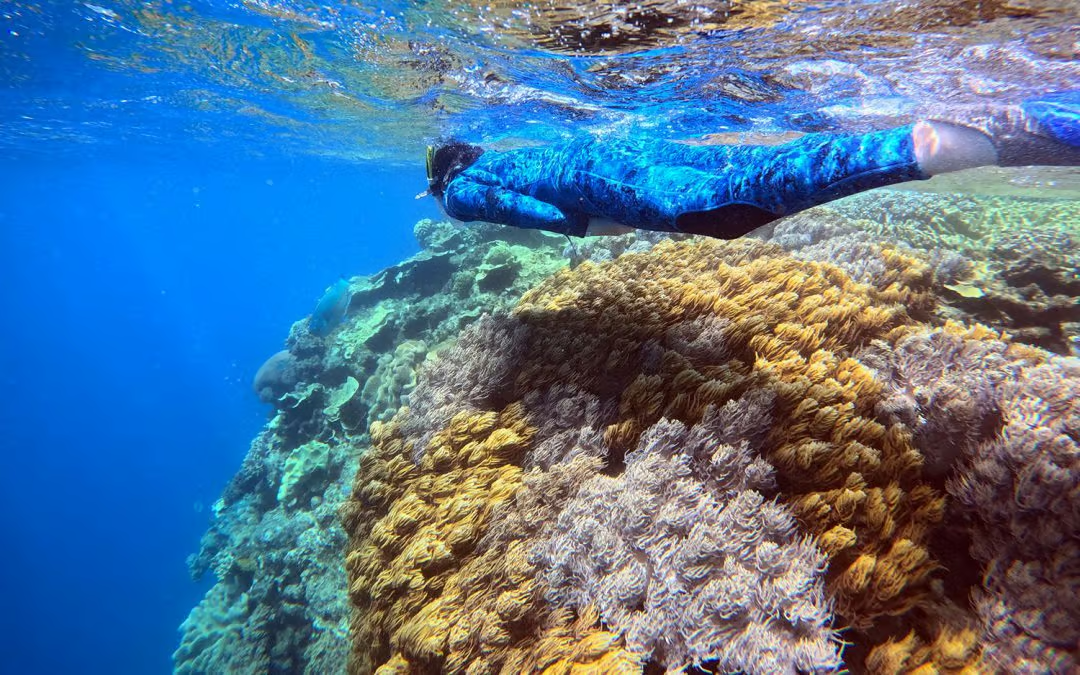
Snorkel or dive from our Moore Reef pontoon, with marine biologists on board to tell you more about the turtles you meet.
Want to see turtle care up close? Read the story of Dennis the sea turtle, or visit the turtle rehabilitation centre on a Fitzroy Island day.
Sea turtle FAQs
Which turtles will I see at Moore Reef?
The 2 species our crew see most often at our Moore Reef sites are the green turtle and the hawksbill turtle. Turtles are wild, so sightings are never guaranteed, but young green turtles are regular visitors around our pontoon.
How can I tell a green turtle from a hawksbill?
Look at the head and shell. A hawksbill has a narrow, pointed, bird-like beak and shell plates that overlap like roof tiles. A green turtle has a shorter, rounded snout and smooth shell plates that sit edge to edge.
Can I touch a sea turtle?
No. Never touch, hold, chase or ride a turtle. All turtles are protected in Australian waters, and touching them causes stress. Watch from a respectful distance and let the turtle decide how close to come.
How often do sea turtles need to breathe?
Turtles breathe air. The Australian Museum notes that green turtles must surface about every half hour to breathe, which is why you should never block a turtle’s path to the surface.
Are green and hawksbill turtles endangered?
Yes. The green turtle is listed as Endangered by the IUCN and Vulnerable in Australia. The hawksbill is listed as Critically Endangered by the IUCN and Vulnerable in Australia.
What should I do if I see an injured turtle?
Tell our crew straight away. You can also report sick, injured or stranded marine animals on 1300 130 372.
Sources: Reef Authority, Marine turtles; Australian Museum, Green Turtle; Australian Museum, Hawksbill Sea Turtle; Jensen MP et al. (2018) Environmental warming and feminization of one of the largest sea turtle populations in the world. Current Biology 28:154-159; Reef Authority, Cairns zoning map and responsible reef practices.
Written by the team at Sunlover Reef Cruises, who run daily trips to Moore Reef on the outer Great Barrier Reef, with marine biologists on board every day.