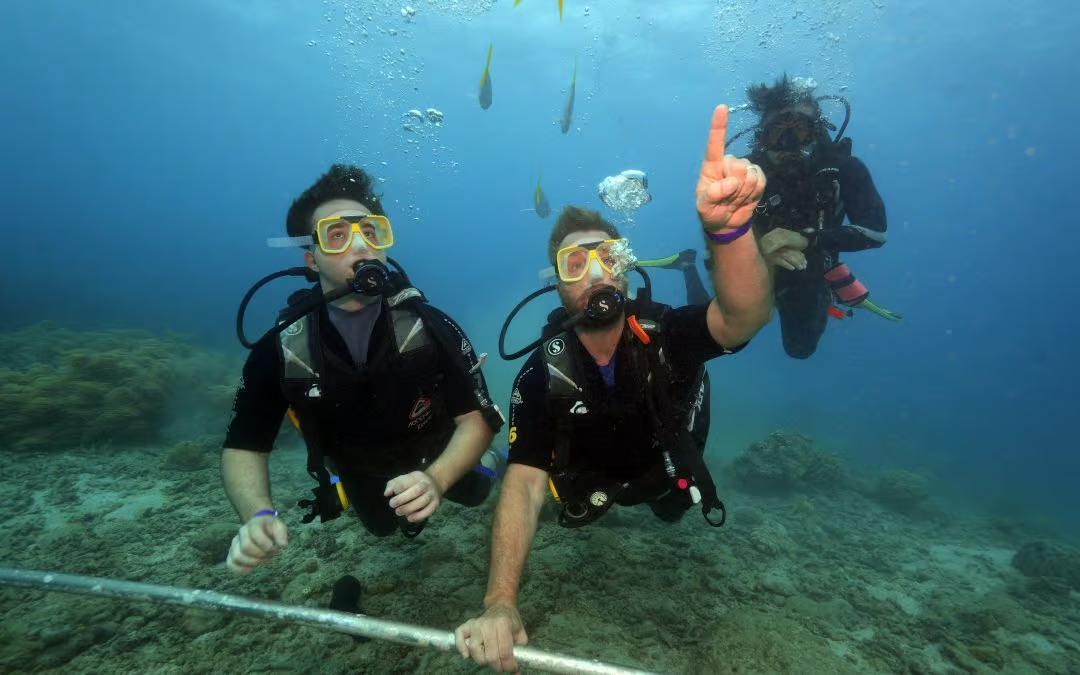
Yes. No training agency sets an upper age limit, and the UK Diving Medical Committee is explicit that there is no maximum age for medical assessment — divers are assessed on their actual health, not their birthday.
What decides it is exercise capacity, cardiovascular health, how your ears behave and how comfortable you are in water. Every one of those is a question for you and a doctor, not for an age bracket.
People ask us this in a particular tone of voice. Not “can someone my age dive” so much as “am I being ridiculous”. So let us deal with the second question first: no, you are not, and the assumption behind it is wrong.
Diving is not a young person’s sport that older people are tolerated in. It is a slow, low-exertion activity in which patience and self-awareness count for more than strength, and both tend to improve with age. Plenty of people take it up in their sixties and seventies. Some of them turn out to be the calmest divers on the boat.
What follows is the honest version: what actually matters, what genuinely gets harder, and what you can do about each of those things.
There is no upper age limit — and that is not just our opinion
None of the recognised training agencies sets a maximum age for certification. The UK Diving Medical Committee, whose guidance is published openly and is a reasonable thing to take to a GP appointment, states that there is no maximum age for medical assessment and no age at which assessment becomes mandatory. Divers are assessed on their presenting medical conditions.
That is the whole principle. A healthy 68-year-old and an unhealthy 38-year-old are not the same proposition, and the system is built to notice the difference rather than count birthdays.
Where age does appear on the form
Everyone completes the RSTC Diver Medical questionnaire before training. Age shows up in exactly one place: being over 45 is listed in combination with other risk factors — smoking, high cholesterol, a family history of heart disease, blood pressure medication, diabetes.
On its own it does nothing. Combined with one of those, it prompts a conversation with a doctor. That conversation usually ends in a signature. Our guide to the medical requirements sets out what the form asks and what happens next.
Do this early. Read the form now, not the week before you travel. If anything on it applies to you, see your GP while you are still at home with time to spare. The most common way people lose a course day is arriving with an unsigned form and no doctor within forty kilometres.
What actually decides it
Can you manage moderate exercise?
Diving itself is undemanding. You move slowly, you do not fight the water, and if you are working hard you are usually doing something wrong. What takes effort is the surrounding business: carrying a tank a short distance, climbing a ladder in gear, and occasionally swimming against a light current at the end of a dive.
The working test dive physicians use is whether you can manage moderate exercise — walking briskly, climbing a few flights of stairs, carrying shopping up a hill — without unusual breathlessness, chest discomfort or having to stop. If you can do that comfortably, you are in the territory where diving is a reasonable proposition.
Your heart, and what you take for it
This is the honest centre of the question. Cardiac events are the thing dive medicine worries about most in older divers, and pretending otherwise would not be doing you a favour.
It is also the most manageable, because it is knowable in advance. A doctor can assess your cardiovascular health properly. Well-controlled blood pressure on stable medication is common among divers and usually straightforward. What matters is control and stability, not the presence of a prescription.
One drug class does warrant a specific conversation: beta blockers blunt the heart rate response to exertion, which is exactly the response you need if you have to work hard unexpectedly underwater. The UKDMC treats them as acceptable at low dose but less preferred, and indicates a diver taking them should be able to reach at least 90 per cent of their age-predicted maximum heart rate on an exercise test. We have covered this in detail in the medical requirements guide.
To be completely clear: do not stop or change any medication in order to go diving. That decision belongs to the doctor who prescribed it. What we are asking is that you raise diving specifically at your appointment, naming the drug and the dose, rather than assuming it will be fine or assuming it rules you out.
How your ears behave
Ear and sinus tissue becomes less forgiving over time, and equalising can take more patience than it did at thirty. This is the single most common practical difficulty for older beginners, and it is largely a technique problem rather than a hard physiological limit.
If you cannot clear your ears on a plane, mention it before the course rather than on the descent line. It is usually fixable.
Are you comfortable in water?
The certification includes a swim assessment: 200 metres unaided in any stroke with no time limit, or 300 metres with mask, snorkel and fins, plus a ten-minute float or tread.
There is no speed component and nobody is marking your technique. If you swam regularly at any point in your life, you will almost certainly still manage it. If you have not been in a pool in twenty years, a few weeks of gentle laps beforehand is the single most useful preparation you can do — for the assessment and for your confidence.
What the water does to your body
Worth understanding, because it explains why the medical questions are what they are.
The moment you are immersed, hydrostatic pressure squeezes blood out of your arms and legs and into your chest. Central blood volume rises and so do the filling pressures in your heart and lungs. Cold water adds to that by constricting the peripheral vessels. Breathing denser gas at depth makes the work of breathing harder.
A healthy circulation absorbs all of it without noticing. That is the reserve a doctor is assessing. It is also why blood pressure control matters in its own right — hypertension is a recognised risk factor for immersion pulmonary oedema, where fluid leaks into the lungs during a dive, because you begin immersion with higher filling pressures already.
None of this is a reason not to dive. It is a reason to have the conversation properly rather than tick “no” and hope.
What genuinely gets harder — and what to do about each
We would be doing you no favours by pretending nothing changes. Here is each thing, and the practical answer to it.
Equalising
What changes: it takes more patience and more frequent, gentler attempts.
What helps: descend on a line rather than free-descending, so you control the rate entirely. Start equalising at the surface and repeat every metre, before you feel pressure rather than after. Descend feet-first. If one ear is stubborn, stop, ascend half a metre, and try again. Tell your instructor on day one so the descent is planned around you rather than despite you.
Feeling the cold
What changes: most people feel cold more as they get older, and being cold makes you tired, clumsy and inclined to rush.
What helps: in Cairns this is close to a non-issue — the water sits around 25 degrees for most of the year. Wetsuits are provided, and stinger suits are free and available year round, not just in stinger season. Plenty of guests wear both. Ask for a hooded vest if you want one; nobody will think it odd.
Carrying the gear
What changes: a full set is genuinely heavy on land, and that is where people hurt themselves, not underwater.
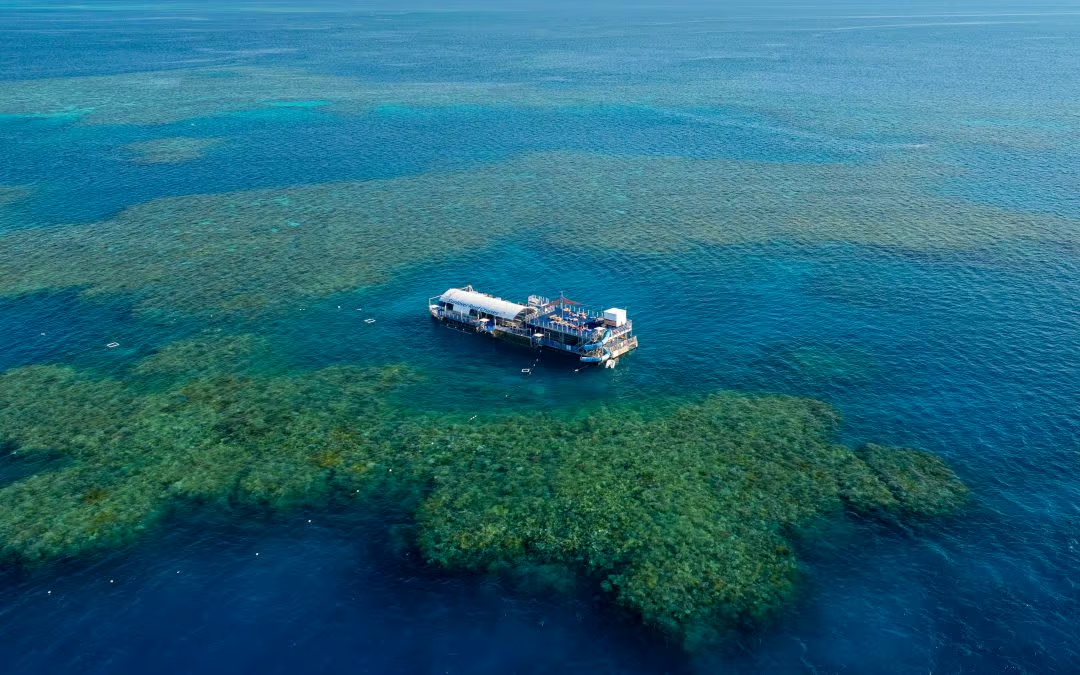
What helps: our courses run from a fixed platform, so you kit up sitting down and step into the water rather than walking a beach in full gear or timing a surf entry. Crew carry tanks. Ask them to — it is their job and they would much rather do it than watch you struggle.
Recovery between dives
What changes: fatigue accumulates faster, and tiredness is when mistakes happen.
What helps: do two dives instead of three. Take longer surface intervals. Sit in the shade, eat properly, and treat the gap between dives as part of the day rather than dead time. Nobody is counting.
Staying hydrated
What changes: thirst signalling weakens with age, and dehydration is a recognised risk factor for decompression sickness.
What helps: drink steadily through the day rather than in response to thirst. Go easy on coffee in the morning and alcohol the night before.
Diving conservatively is not a consolation prize
There is a quiet assumption in a lot of diving culture that deeper and longer is better. It is not, and older divers are often better at knowing that.
A shallower, shorter, well-planned dive with a generous safety stop is a better dive than one spent at the edge of your limits. Most of what is worth seeing on a coral reef is in the top fifteen metres anyway — that is where the light is, and where the fish are. Diving well within your certification limits is not settling for less; it is the experienced choice.
Talk to your instructor about profiles that suit you rather than the group default. It is a completely normal request.

Why reef training suits older beginners particularly well
This is not a sales point so much as a structural one.
Cold, dark, low-visibility training water makes every early skill harder than it needs to be, and that penalty falls hardest on anyone who is already managing something else — a stiff shoulder, a fussy ear, a bit less patience for being uncomfortable.
Warm, clear, shallow water where you can see your instructor’s face, entered from a stable platform, with four students rather than eight, removes a great deal of unnecessary difficulty. There is also somewhere to sit, shade, food, a toilet and crew within arm’s reach — which sounds trivial and is not.
And if a partner is not diving, they can snorkel, take the glass bottom boat or simply sit in the sun rather than being stuck at home.
How to prepare, in the months before
None of this is strenuous, and all of it makes the course easier.
- Read the medical questionnaire now. If anything applies, book the GP appointment early.
- Walk. Building up to brisk walking and a few flights of stairs without stopping is close to the exact fitness diving asks for.
- Swim. A few gentle laps a week for a month or two, if it has been a while. It is confidence as much as fitness.
- Get your ears checked if they have ever given you trouble on a plane.
- Do the online theory at home in your own time, so you arrive ready to dive rather than to read.
- Leave a clear day before you fly home — at least 18 hours after your last dive.
If you are not sure, do not start with the course
The sensible move for anyone hesitant, at any age, is a supervised introductory dive first. One instructor, a maximum of four divers, shallow water, no commitment beyond the day. $149.
You will know within about five minutes of breathing underwater whether this is something you want more of. That is a far better basis for spending $1,030 than reading another article, including this one.
And if it is the mask and the mouthpiece that put you off rather than the depth, the Seawalker helmet dive keeps your face dry entirely — you walk on the sea floor with your head inside a helmet. It is genuinely popular with people who do not consider themselves water people.
Common questions
Is 60 too old to start diving?
No. No recognised agency sets an upper age limit, and the UK Diving Medical Committee states there is no maximum age for medical assessment. Fitness, health and comfort in water determine suitability, assessed individually.
Is 70 too old?
The same answer applies. There is no age at which the assessment changes — it is always based on your presenting health rather than a threshold. People certify in their seventies.
Do I need a full dive medical because of my age?
Not automatically. You complete the standard RSTC questionnaire like everyone else. Age over 45 appears only in combination with other risk factors, and triggers a doctor’s review of that specific point rather than a full examination.
What if I take blood pressure medication?
Extremely common among divers and usually straightforward if it is well controlled and stable. Beta blockers warrant a specific conversation with your doctor because of how they affect the heart rate response to exertion. Never stop or adjust medication in order to dive.
I have had a knee or hip replacement. Does that rule me out?
Not in itself. What matters is mobility and whether you can manage the surrounding physical business comfortably. Raise it on the medical form and with your doctor, and tell your instructor so entries and exits can be planned around it.
Can I do the course over more days?
Ask. Spreading the training out is often possible and is a completely reasonable request rather than an awkward one.
Will I hold the group up?
Instructors expect people to progress at different rates, and with a maximum of four divers to an instructor there is room for it. In our experience it is rarely the older students who need the extra time — they tend to listen more carefully and rush less.
How cold is the water?
Around 25 degrees at Moore Reef for most of the year. Wetsuits are provided, and stinger suits are free and available year round — many guests wear one for warmth and sun protection regardless of season.
How many dives will I do in a day?
That is negotiable. Two well-spaced dives with a proper rest between them is a perfectly good day and often a better one than three rushed ones. Say what you want early rather than pushing through.
Warm water, four divers to an instructor, somewhere to sit
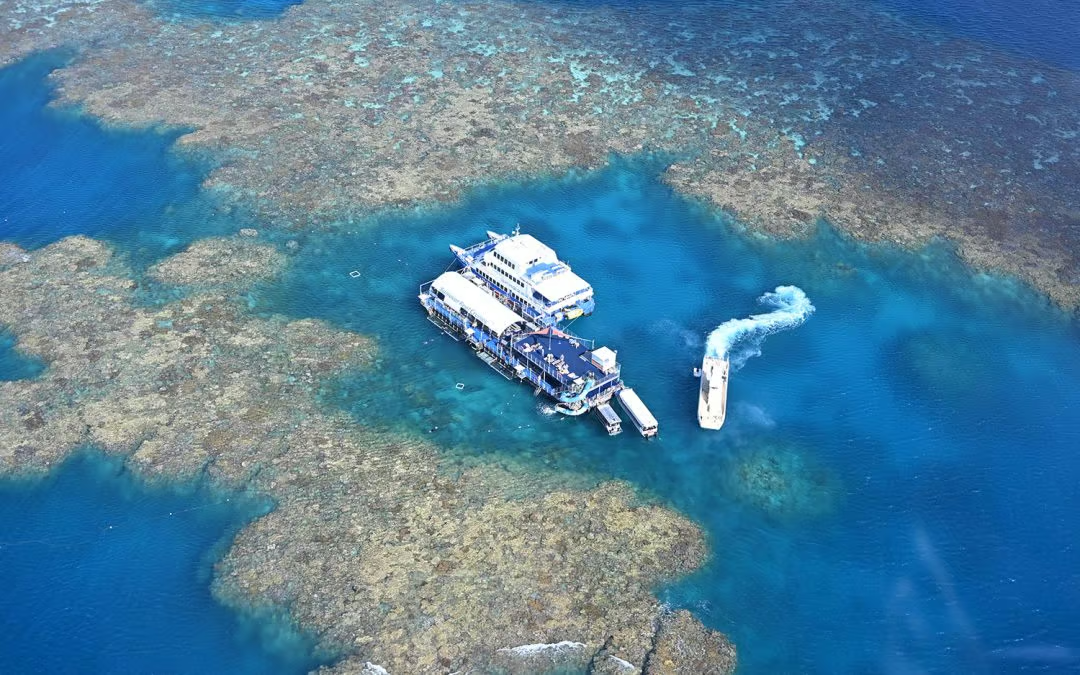
Our SSI courses are bookable now and run from the pontoon at Moore Reef — entry from a fixed platform, all equipment carried and provided, back in Cairns every night.