Almost every dive centre in Australia advertises a price. Very few of them advertise the same thing. That is why “how much does a scuba course cost” is such an unsatisfying question to search — you get a spread of numbers with no way to tell which ones are comparable.
So here is the honest version, including ours, and a way to compare 2 quotes properly.
The short answer
An entry-level Open Water certification in Australia in 2026 generally sits between $600 and $1,100. The bottom of that range is usually pool-and-local-site training over a few weekends. The top is usually 3 or 4 consecutive days of boat-based training on a reef.
Both certifications are identical. What differs is the experience and what is bundled in.
Why the range is so wide
5 things move the number, and only one of them is profit margin.
1. Where the training dives happen
This is the biggest single factor. Pool time is cheap. A vessel running to the outer Great Barrier Reef and back, crewed, fuelled and maintained, is not. If a course includes several days of boat access, that cost has to sit somewhere.
2. How many students share an instructor
An instructor with 8 students costs a centre half as much per head as an instructor with 4. You will feel the difference on day one, when you are waiting your turn to try a skill instead of doing it.
3. Whether equipment is included
Most reputable centres include it. Some quote the course and charge hire separately. Neither is wrong, but only one of them is comparable to the other on price alone.
4. Reef and marine park fees
On the Great Barrier Reef these are real, per-person, per-day charges. They should be stated in the advertised price. If a quote seems unusually low, this is the first place to look.
5. Certification processing
The fee to actually issue your card. Small, but occasionally added at the end, which is exactly when nobody wants a surprise.
What ours costs, and what is in it
We would rather put the number up than make you ask for it.
| Course | Price | What it covers |
|---|---|---|
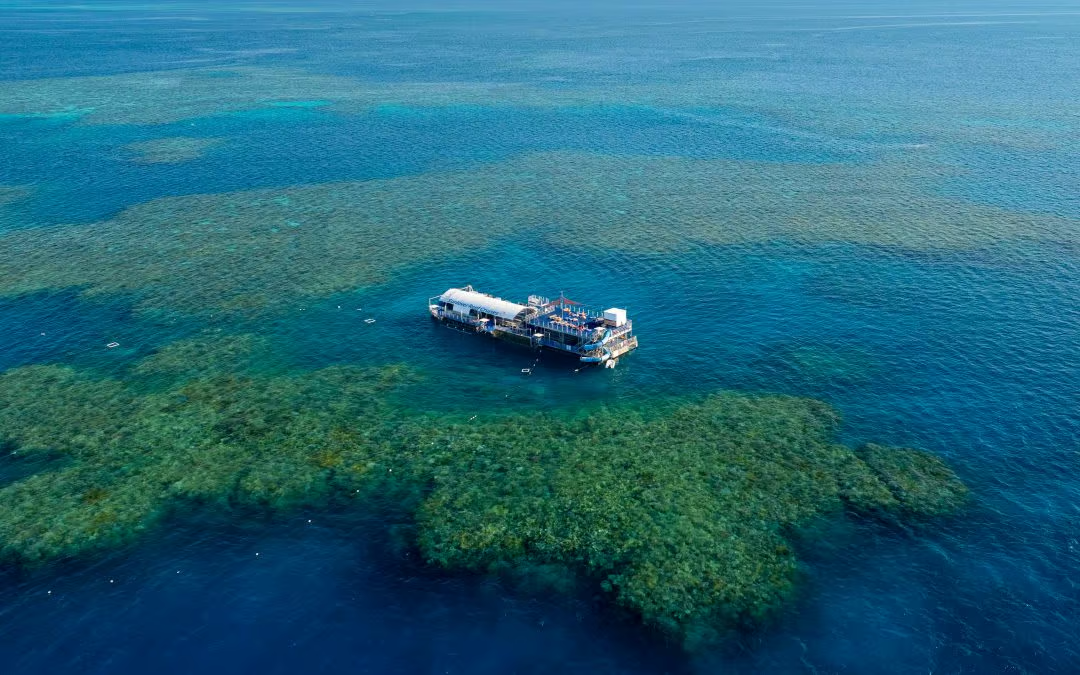
| SSI Open Water Diver | $1,030 | Online study, 3 days at Moore Reef, 9 training dives, all equipment, certification |
| SSI Advanced Open Water | $870 | 2 days, 6 dives, all equipment, certification. Open Water required |
| SSI Diver Stress & Rescue | $905 | 2 days, 5 training dives plus a recreational dive. Open Water plus First Aid, CPR & O₂ required |
| Return to Diving SSI Scuba Skills Update |
$228 + reef fare | Half-day refresher plus one dive, for certified divers who have been away. Minimum age 10. A recognition program rather than a certification, so you finish with a digital recognition card. Unlike the 3 courses above, this is an add-on to your Moore Reef fare rather than an all-in price |
The 3 course figures are complete. Reef access, equipment and certification are inside them, nothing is added at the end, and there is no “from”. The Return to Diving refresher is the one exception, and it is marked as such above — it is an upgrade to a Moore Reef day rather than a course in its own right, and it is a recognition program rather than a certification.
If you want to try diving before committing to a course, an introductory scuba dive is $149 with no certification needed, and a second dive on the same day is $99.
Is a more expensive course a better course?
Not automatically, and we will not pretend otherwise.
A cheap course run by a patient instructor with 4 students in a clean pool will teach you to dive properly. An expensive course run badly will not. Price is a signal about what is included and where it happens — it is not a proxy for teaching quality.
What price does reliably tell you is whether a centre is being straight with you. A number that grows between the website and the invoice is worth more attention than a number that is simply higher.
How to compare 2 quotes properly
Ask both centres the same 5 questions and write the answers down:
- Is every fee included? Equipment, reef and marine park charges, certification processing, fuel levies.
- How many students per instructor? A number, not “small groups”.
- Where do the confined-water skills happen, and where do the open-water dives happen?
- How many dives do I get? Agency minimum is 4. Some courses run more.
- What happens if I need an extra day? Ask what that costs before you need it.
2 quotes $300 apart often stop being $300 apart once you have those 5 answers.
Is it worth it?
That depends entirely on what you compare it to.
Against a single day out, $1,030 is a lot of money. Against a qualification that never expires, is recognised in every diving country on earth, and turns every coastline you ever visit into somewhere you can dive — it stops looking like a holiday expense and starts looking like a one-off.
People who certify and then dive twice more in their lives got poor value. People who certify and keep diving got the best value of anything they bought that year. Which of those you are is the only variable that actually matters, and it is not one we can answer for you.
Common questions
Is it cheaper to learn overseas?
Often, yes — South East Asia in particular. What you are trading is oversight, group size, and recourse if something goes wrong. Some overseas centres are excellent. Standards enforcement varies far more than price does.
Can I pay in instalments?
Ask. Many centres, including us, can work with a deposit and a balance closer to the date.
Do I need to buy equipment?
No. Everything is provided. Some people buy their own mask because a well-fitting one makes the first days easier, and that is genuinely the only thing worth buying up front.
Are the online materials an extra cost?
Not with us — the digital learning is inside the course price. Check this with any centre you compare, as it is a common add-on.
Where to go from here
Our SSI courses are bookable now and run from the pontoon at Moore Reef on the outer Great Barrier Reef. Prices and structure are on the Learn to Dive page, and the wider process is covered in our guide to getting scuba certified in Australia.