Getting scuba certified is one of those things that looks more complicated from the outside than it turns out to be. There are competing agencies, a medical form, a swim test, and a lot of websites that would rather sell you something than explain the process. So here is the whole thing, start to finish, with nothing left out.
This is written from Cairns, by people who run dive training on the Great Barrier Reef. We have an interest in you learning to dive. We do not have an interest in you learning to dive badly, or somewhere that does not suit you, so where the honest answer is “it depends”, we have said so.
The short version
To dive independently anywhere in the world, you need an entry-level certification — usually called Open Water Diver. You get it by completing theory, then a set of supervised training dives with a qualified instructor. It takes three to four days, costs somewhere between $600 and $1,100 in Australia, and once you have it, it never expires.
There is no government licence involved. There is no exam you can fail in the way people imagine. And you do not need to be an athlete — you need to be reasonably comfortable in water and honest on a medical form.
Everything below is the detail.
Step one: understand what you are actually buying
A recreational diving certification is issued by a training agency, not by a government. The main ones operating in Australia are SSI, PADI, SDI, NAUI and RAID.
All of them are members of the same standards body — the Recreational Scuba Training Council — which means the minimum requirements for an entry-level course are effectively identical no matter whose logo is on the card. Same skills, same depth limit, same theory. A dive centre in Indonesia or Egypt or Mexico will accept any of them.
So the agency matters far less than the internet suggests. What matters is the dive centre: how many students there are per instructor, where your training dives happen, and what the people teaching you are actually like. We have written a longer piece on the difference between PADI and SSI if you want that argument in full.
What the entry-level certification lets you do
- Dive to a maximum of 18 metres
- Dive anywhere in the world, with a buddy, without an instructor
- Hire equipment and book on dive boats as a certified diver
- Keep it for life — there is no renewal fee and no expiry date
That last point is the one people underestimate. You are not buying a holiday activity. You are buying a qualification you will still hold in thirty years.
Step two: check the medical side before you book anything
This is the step people leave until last, and it is the one most likely to cause a problem.
Every diver completes a standard medical questionnaire before training — the RSTC Diver Medical form. It asks about heart and lung conditions, ear and sinus problems, neurological history, diabetes, medications, pregnancy and mental health. Most people tick “no” to everything and that is the end of it.
If you tick “yes” to anything, it does not mean you cannot dive. It means a doctor needs to look at it first and sign off. Plenty of people who answer yes to something go on to dive perfectly safely. But leaving it to the morning of your course is how people lose a booking, because there may not be a doctor available that day.
Do this early. Read the form, and if anything applies to you, see your GP well before you travel. Our health checklist covers what we ask and why.
Do you need to be a strong swimmer?
You need to be a competent one, not a fast one. The standard assessment is a continuous 200-metre swim with no aids — any stroke, no time limit — or 300 metres with a mask, snorkel and fins, plus a ten-minute float or tread.
There is no speed requirement. Nobody is watching your technique. It exists so that if something goes wrong on the surface, you are not in trouble.
If that sounds beyond you right now, it is a reason to spend a few weeks in a pool before you book — not a reason to give up on the idea.
Step three: work out how much it costs
Entry-level certification in Australia generally runs between $600 and $1,100. That is a wide range, and the reason is what is included.
| What changes the price | Why it matters |
|---|---|
| Where the training dives happen | Pool and local-bay training is cheaper to run than reef training. Boat time costs money. |
| How many students per instructor | Small groups cost more to staff and are considerably better to learn in. |
| Whether equipment is included | Some centres charge separately for hire. Ask. |
| Whether reef or marine park fees are included | On the Great Barrier Reef these are a real cost and should be stated up front. |
| Certification and processing fees | Occasionally added at the end. It should be in the advertised price. |
For reference, our SSI Open Water Diver course is $1,030, which covers online study, three days on the outer Great Barrier Reef, nine training dives, all equipment, and your certification. Nothing is added afterwards.
Cheaper courses exist, and some of them are good. What we would say is this: compare what is actually included before you compare the numbers, and be suspicious of any price that arrives with a “from”.
Step four: choose where to learn
Most Australians certify in one of two ways. Either they do it locally — a pool, then a few dives at a nearby site — or they do it on holiday, usually on the Great Barrier Reef.
Both produce the same certification. They are very different experiences.
Learning locally
Cheaper, closer, and spread over a few weekends so it fits around work. You learn in controlled conditions, which suits people who want to take their time. The trade-off is that your first nine dives are in water you would not otherwise choose to dive in, and cold, low-visibility conditions make the early skills harder than they need to be.
Learning on the reef
More expensive, and it needs a block of consecutive days. But your training dives are dives you would pay to do anyway, in twenty-five degree water with visibility measured in tens of metres. Skills are easier to learn when you can see what you are doing and you are not cold.
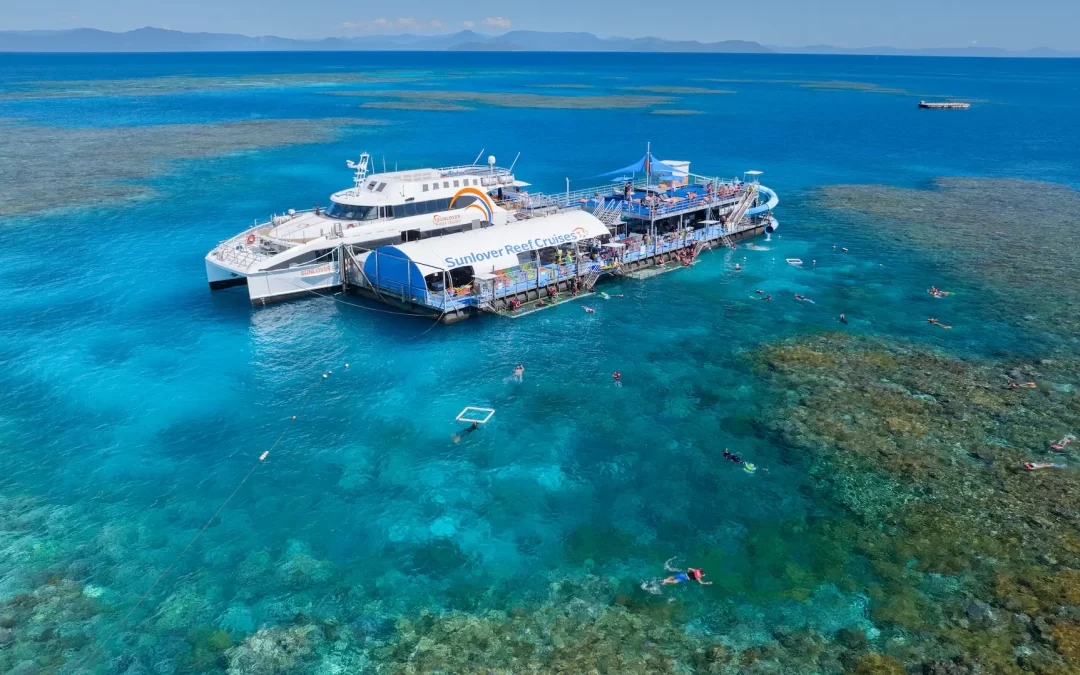
Our own courses run entirely from the pontoon at Moore Reef, on the outer reef — no pool, no liveaboard, back in Cairns every evening. That is a deliberate choice, and it is the main reason people book with us rather than closer to home.
Step five: know what the course actually involves
Every entry-level course has the same three parts, whatever the agency calls them.
- Theory. Pressure, breathing, buoyancy, planning a dive, reading a computer, what to do when something is not right. Now done online, at home, in your own time — usually eight to twelve hours spread over as long as you like. Do this before you travel.
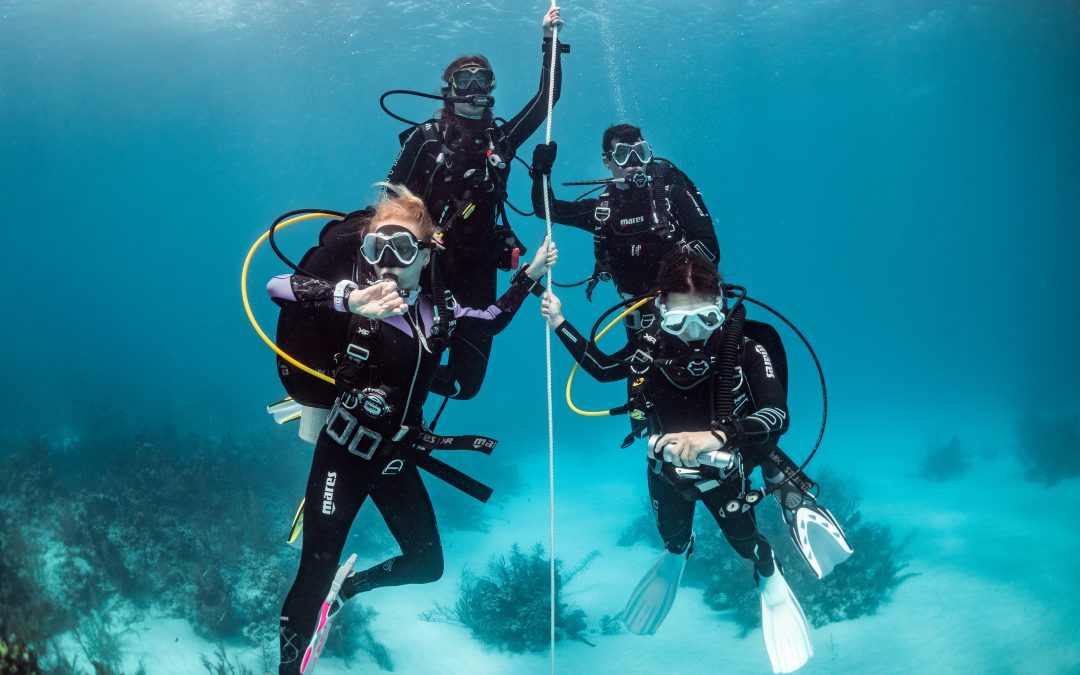
- Confined skills. Mask clearing, regulator recovery, buoyancy control, sharing air. Traditionally done in a pool; we do them in a shallow, sheltered area beside the pontoon.
- Open water dives. Four dives minimum under most agencies’ standards, where you repeat the skills at depth and then simply dive. Our course runs nine.
How long it takes
Three to four consecutive days in the water, plus however long the theory takes you at home. If you do the online portion before you arrive, you are diving on day one rather than sitting in a classroom.
What happens if you struggle with something
You repeat it. That is genuinely all. There is no pass mark on the water skills — there is a standard, and you work at it until you meet it. Some people clear a mask first go and some people need six attempts, and instructors have seen both a thousand times. We have written separately about what happens if you do not finish.
Step six: after the card
The certification is the beginning, not the end. The two things worth knowing on day one:
Dive soon, and dive again. Skills fade. The single best thing you can do after certifying is a few more dives within the following months, while everything is still fresh. If you leave it years, a refresher is the sensible move — ours is Return to Diving at $228.
Do not book a flight for the same day. Flying too soon after diving carries a real decompression risk. Standard guidance is to leave at least eighteen hours after multiple dives before you fly. Plan a clear day at the end of your trip.
Common questions
Do I need a licence to scuba dive in Australia?
No. There is no government-issued diving licence in Australia. What you need is a certification from a recognised training agency, and you only need that to dive independently. Supervised introductory dives require no certification at all.
What is the minimum age?
Twelve for a full Open Water certification with most agencies, including ours. Younger children can usually do supervised shallow-water programs.
Is there an upper age limit?
No. Fitness and health matter; birthdate does not. People certify in their sixties and seventies every year.
Can I try diving before committing to a course?
Yes, and we would encourage it. An introductory dive is a supervised dive with an instructor, no certification required — ours is $149. It is the cheapest way to find out whether you actually like being underwater before spending a thousand dollars on finding out.
Does the certification expire?
No. It is valid for life and recognised worldwide. Some dive centres will ask for a refresher if you have not dived in a couple of years, which is a safety judgement rather than an expiry.
What if I wear glasses or contact lenses?
Contact lenses are fine and extremely common. Prescription masks are available if you prefer, and worth arranging before you travel rather than on the day.
Where to start
If you are still deciding whether diving is for you, do a supervised introductory dive first. If you already know you want the certification, book the course and get the online theory done before you arrive.
Our SSI courses open on 1 October 2026 and run from the Moore Reef pontoon on the outer Great Barrier Reef — Open Water Diver, Advanced Open Water, and Diver Stress & Rescue. You can see the full structure and pricing on the Learn to Dive page.
And if you have a question this has not covered, ask us. We would rather answer it now than have you find out on the boat.